Food is one of the most underrated mechanics in Genshin Impact, yet it can be the difference between clearing the Spiral Abyss and getting stuck on the same floor for weeks. Whether you’re a casual player exploring Teyvat or a hardcore grinder pushing endgame content, understanding Genshin Impact food and how to cook efficiently will dramatically improve your survivability and DPS output. This guide covers everything from basic cooking mechanics to advanced optimization strategies that competitive players use to farm domains and tackle challenging bosses. You’ll learn which recipes matter most at every stage of the game, where to find ingredients efficiently, and the hidden mechanics that most players miss.
Table of Contents
ToggleKey Takeaways
- Genshin Impact food becomes essential at World Level 6 and beyond, dramatically improving survivability and enabling riskier team compositions in challenging content like Spiral Abyss.
- Premium healing dishes like Suspicious Jewelry Soup (38% max HP recovery) are the foundation of endgame strategy, with seafood ingredients respawning infinitely on the Liyue Coast.
- Master the hidden cooking success mechanic by timing button inputs during the cooking animation to achieve 90%+ success rates instead of the baseline 70%, reducing failed suspicious dishes.
- Build organized recipe kits for different scenarios—exploration, domain farming, and Spiral Abyss—with proper quantities (40-60 healing dishes, 20-30 ATK boosts) prepped every two weeks.
- Character cooking talents from Xiangling, Barbara, and Bennett automatically produce bonus dishes, effectively increasing yield by 10-15% and saving significant preparation time for endgame attempts.
- Avoid common mistakes like cooking low-tier recipes at high Adventure Ranks, overcooking specialty dishes for casual content, and ignoring 24-48 hour ingredient respawn timers that maximize farming efficiency.
Understanding Genshin Impact’s Cooking System
How Cooking Works and Why It Matters
Cooking in Genshin Impact is deceptively simple on the surface but has surprising depth once you dig in. You place food items in a pot, apply heat for a set amount of time, and either succeed or fail based on RNG and your cooking accuracy. Success gives you the intended dish at full potency. Failure usually produces a “suspicious” or “burned” version that’s either weaker or useless. This isn’t flavor text, a Suspicious Vegetable Soup heals 24% of max HP instead of 30%, which adds up across multiple consumptions in endgame challenges.
Cooking isn’t mandatory for casual play, but it becomes essential once you hit World Level 6 and beyond. Bosses hit harder, enemy density increases, and your healing from characters alone won’t cut it. Well-cooked meals let you run riskier team compositions, stay in the field longer, and recover from mistakes that would otherwise force a restart.
Kitchen Mechanics and Ingredient Sourcing
You can cook anywhere by opening a cooking station, campfires, stoves in domains, or kitchens scattered across Teyvat. Cooking takes 8 seconds per dish, so batch-cooking multiple copies of the same recipe is faster than mixing items. This is crucial when prepping for Spiral Abyss runs.
Each recipe requires specific ingredients, and drop rates vary by region. A player can’t farm Mint in Mondstadt if it’s exclusive to Liyue, so understanding ingredient distribution early saves hours of wasted searching. Some ingredients spawn infinitely and respawn after 24-48 hours (real time). Others come from enemies, chests, or NPC shops where they cost Mora or recipes. The most efficient farming involves planning a route that hits multiple ingredient spawns in sequence, using Elemental Sight to spot pickups quickly.
One underrated mechanic: characters with cooking talents (like Xiangling, Fischl, or Barbara) occasionally produce extra dishes when you cook. With the right setup, you can get 1-2 bonus meals per batch for free, effectively multiplying your yield by up to 12% per cook session.
Categories of Food and Their Primary Benefits
HP Recovery Dishes
HP recovery foods are the foundation of any serious player’s rotation. These directly replenish health and are split into three tiers:
- Basic tier (heal 16-20% of max HP): Mushroom Pizza, Vegetable Soup, Rice Cake. Used for early-game exploration and casual domains.
- Standard tier (heal 24-30% of max HP): Vegetable Soup (suspicious), Tomato Meat Sauce, Apple Pie. These are your daily drivers for mid-game content.
- Premium tier (heal 34-40% of max HP): Jewelry Soup, Suspicious Meat Pie, Steak. Expensive ingredient-wise but necessary for Spiral Abyss and elite boss farms.
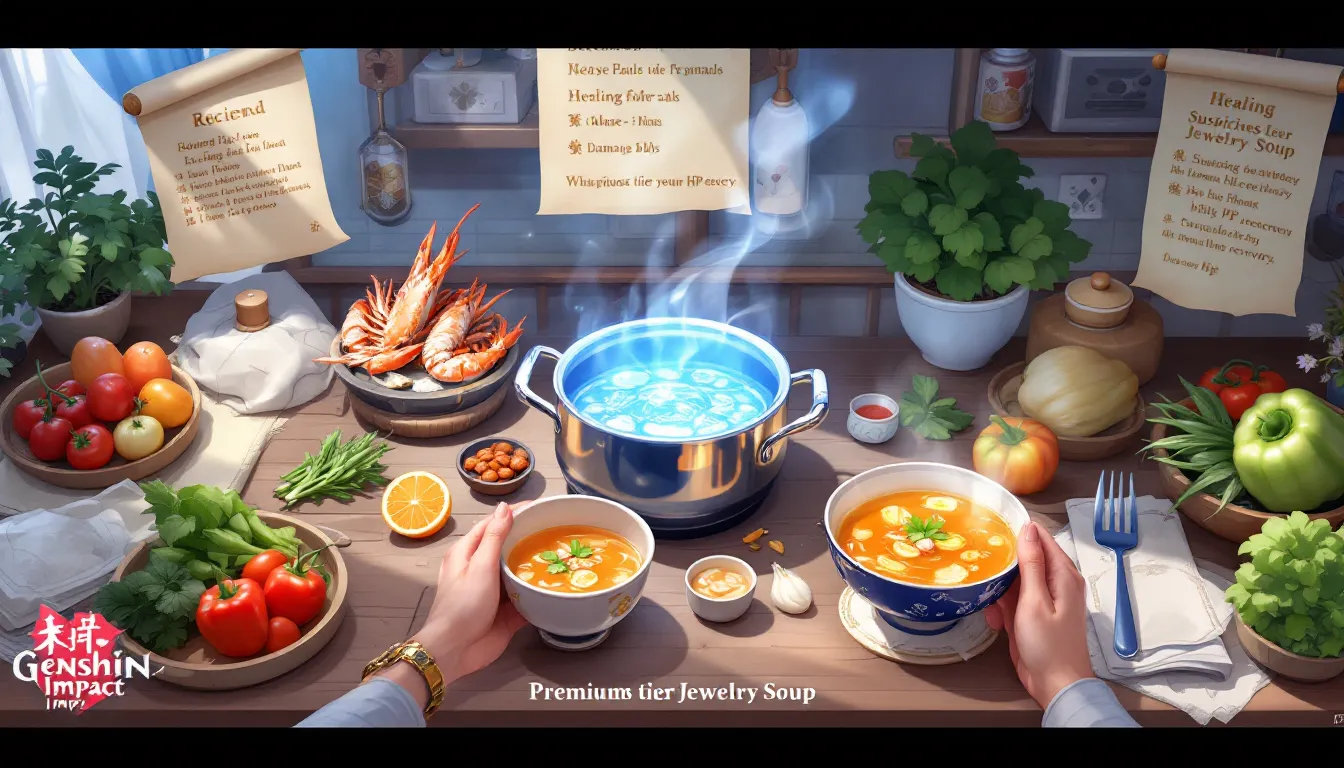
The real MVP is Suspicious Jewelry Soup, which heals 38% of max HP. It requires Crab, Shrimp, and Fish, all farmable on a respawn cycle. Competitive players cook dozens of these before attempting Abyss runs because they don’t have cooldown timers between consumptions.
Attack and Elemental Boost Foods
These foods buff your damage output for 300 seconds (5 minutes), making them perfect for burst DPS windows or time-restricted challenges.
- ATK% boosts: Jade Parcels (+25% ATK), Spicy Stew (+75 ATK), Wonton Soup (+25% ATK). The percentage-based ones scale better with leveled characters.
- Elemental DMG boosts: Steak (+25% Physical DMG), Vegetable Dishes (+25% Electro DMG), various regional variants for Hydro, Cryo, Pyro, and Geo.
These are situational rather than essential. In Spiral Abyss, if a floor favors Electro damage, cooking a batch of Electro-boosting foods before the challenge makes a noticeable difference. For everyday domains, they’re often skipped because the buff duration is shorter than boss fight timers.
Defense and Stamina Enhancement Foods
Defense foods reduce incoming damage by a percentage or add flat shields. Stamina foods lower sprinting/climbing costs, letting you explore longer and fight without depleting your stamina bar.
- Defense boosts: Fish and Chips (+20% DEF), Fruit Salad (+30% DEF). Used for tanky teams or when you’re undergeared for content.
- Stamina reduction: Powder Meat (sprinting costs 15% less stamina), Vegetable Stew (climbing costs 15% less). These are niche but essential for specific exploration challenges or timed dungeons.
Most endgame players skip these entirely, preferring to use healing and ATK buffs. But, when a Spiral Abyss floor has environmental hazards or aggressive enemy patterns, stacking defense foods can prevent one-shots that would otherwise happen.
Movement and Resistance Foods
These foods grant movement speed boosts or Elemental Resistance to Cryo, Pyro, Electro, Hydro, and Geo.
- Movement: Noodles with Mountain Delicacies (+10% movement speed). Most players don’t bother with these.
- Resistance: Sake with Grilled Fish (Cryo Resistance +25%), Grilled Tiger Fish (Electro Resistance +25%), various regional dishes. These are lifesavers when you’re exploring Dragonspine (Cryo damage), Domains of Guyun (Geo slimes), or fighting Electro Hypostasis bosses.
They’re situational but underrated. Bringing Cryo Resistance when farming Dragonspine lets you explore longer without constantly switching to Pyro characters for shield breaks.
Top Recipes Every Genshin Impact Player Should Know
Essential Beginner Recipes
If you’ve just started Genshin Impact, focus on these three recipes until you hit Adventure Rank 30:
- Vegetable Soup (recovers 16% max HP + 100 HP flat): Uses Cabbage, Tomato, and Carrot, all found in Mondstadt fields. Easy to cook and available immediately.
- Mushroom Pizza (recovers 20% max HP + 80 HP flat): Uses flour, cheese, tomatoes, and mushrooms. Slightly better than Vegetable Soup and teaches you ingredient diversity.
- Fruit Salad (recovers 16% max HP + 100 HP flat): Uses Apple, Berry, and Carrot. Another basic option for early exploration.
Don’t overthink early-game cooking. Your characters heal fast, and HP loss is usually your mistake, not a mechanical failure. Focus on unlocking recipes and understanding ingredient locations. Players following Genshin Impact Guide: Essential Tips for New and Returning Players will find additional foundational info that complements food strategy.
Mid-Game Staples and Efficient Options
Once you hit AR 30-40, you should unlock recipes that actually matter:
- Suspicious Vegetable Soup (recovers 30% max HP): Uses Cabbage, Tomato, and Carrot, same ingredients as regular Vegetable Soup, but the success version heals 30% instead of 24%. Cook this batch when you need consistent healing.
- Tomato Meat Sauce (recovers 28% max HP + 110 HP flat): Requires Tomato and Meat. Meat drops from almost any enemy, making this infinitely farmable.
- Jewelry Soup (recovers 30% max HP + 70 HP flat): Uses Crab, Shrimp, and Fish, all found near water sources. This is your gateway recipe to premium farming.
The difference between “mid-game” and “endgame” recipes is ingredient availability and cooking success rates. By AR 40, you should have unlocked enough recipes that failure doesn’t sting because you’re cooking premium ingredients, and their success versions are significantly better than failure versions.
Late-Game and Domain Challenge Foods
For Spiral Abyss, elite domains, and boss farming, these are non-negotiable:
- Suspicious Jewelry Soup (recovers 38% max HP + 200 HP flat): The absolute premium healing food. Requires Crab, Shrimp, and Fish, all cheap to farm and spawn infinitely. This single recipe is the reason food matters in endgame.
- Suspicious Meat Pie (recovers 34% max HP + 310 HP flat): Uses Meat, Cheese, and Tomato. Easier ingredient accessibility than Jewelry Soup, making it a viable alternative.
- Jade Parcels (ATK +25%): Uses Mint, Cabbage, and Ham. Cook 20-30 of these before tackling difficult Abyss floors.
For difficult Spiral Abyss chambers, the meta approach is: cook 30-40 healing dishes, 20-30 ATK boost dishes, and maybe 10 elemental resistance dishes (if relevant). Consume healing food during fights, use ATK buffs before boss phases, and slot resistance food only if the floor’s environmental damage is a real threat.
Your Genshin Impact Tips: Essential Strategies for New and Returning Players will include combat rotation tips that food complements perfectly.
Ingredient Locations and Farming Routes
Common Ingredients by Region
Each region favors certain ingredients. Learning where to find them cuts farming time dramatically.
Mondstadt is your go-to for early-game staples:
- Cabbage, Tomato, Carrot (fields near Dawn Winery and Wolvendom)
- Mushroom (forest areas, especially near Whispering Woods)
- Apple (trees scattered throughout)
- Mint (small spawns near water, very common)
Liyue opens mid-game options:
- Crab, Shrimp, Fish (coast near Liyue Harbor, respawn infinitely)
- Lotus Head (ponds and water sources)
- Bamboo Shoot (forests in Qingce Village)
- Ham (drop from Boar enemies, guaranteed with the right kills)
Inazuma adds premium ingredients:
- Shoga (Inazuma fields, slightly rarer)
- Sakura Bloom (exclusive to Inazuma, but unnecessary for meta cooking)
- Seafood (fishing spots like other regions)
Sumeru introduced newer recipes but doesn’t shift the meta for healing. Most endgame players stick with Liyue coast farming because Crab and Shrimp spawn in huge clusters.
Efficient Farming Strategies
Don’t just wander looking for ingredients. Plan a route that hits multiple spawns sequentially.
The Liyue Coast Run (5-7 minutes per cycle):
- Start at Liyue Harbor waypoint
- Run south to the beach and collect all visible Crab and Shrimp (typically 8-12 items)
- Move to the island area near Guyun Stone Forest and collect more seafood
- Return after 24-48 real-world hours for respawns
This single route yields 40-60 seafood items per 24-hour period. Cooking with these ingredients exclusively, you can prep 50+ healing dishes in a week with minimal effort.
The Mondstadt Fields Run (3-5 minutes):
- Teleport to Dawn Winery
- Collect Cabbage, Tomato, Carrot from surrounding fields
- Move to Wolvendom and grab more vegetables
- Total yield: 20-30 vegetables per run
This route is faster but less efficient per ingredient because vegetables aren’t as concentrated. Use this early, then switch to Liyue Coast farming once you unlock it.
Pro tip: Use interactive maps (like Twinfinite’s Genshin Impact guides) to visualize spawn locations before farming. Seeing the exact spots saves exploration time and prevents revisiting areas.
Also, fishing spots respawn like harvested ingredients. If you’re near water, spend 30 seconds fishing instead of running past. You’ll accumulate Carp and Eel relatively quickly, and several recipes use them.
Advanced Cooking Tips and Optimization Strategies
Maximizing Cooking Success Rates
Cooking has a hidden success mechanic: holding the button down during the cooking window affects success rates. Mash or hold at the exact right moment, and you’re more likely to succeed. This takes practice, but high-level players nail it consistently.
The timing window varies per recipe (slightly shorter or longer), and the visual/audio cues help. Watch the pot carefully, when the food looks “done” based on the animation, that’s your signal. Getting it right consistently increases your success rate from ~70% baseline to 90%+, which means fewer “suspicious” dishes wasting ingredients.
Another factor: some characters’ cooking talents add bonuses. Xiangling produces 1-2 extra dishes automatically when you cook. Barbara and Bennett have similar talents. If you’re cooking hundreds of dishes before a Spiral Abyss run, having these characters in your party is a 10-15% yield increase.
Finally, Suspicious dishes aren’t always bad. They’re typically 75-80% as effective as the normal version. In a pinch, consuming 2-3 suspicious healing dishes instead of one normal dish can save you from a wipe. So don’t trash them, use them strategically.
Building Your Recipe Bank for Different Scenarios
Endgame players maintain multiple recipe stashes organized by purpose:
Exploration Kit (for dailies, casual domains):
- 10-20 Vegetable Soup (cheap, effective)
- 5 Fruit Salad (backup)
- A handful of stamina-reducing dishes if you’re climbing mountains
Domain Farming Kit (for elite domains, talent books, weapon materials):
- 30-50 Jewelry Soup or Meat Pie (your workhorse healing)
- 10-15 Jade Parcels or Spicy Stew (ATK buffer if you need faster clears)
Spiral Abyss Kit (for serious attempts):
- 40-60 Suspicious Jewelry Soup (premium healing)
- 20-30 Jade Parcels (ATK buff)
- 15-20 elemental resistance dishes (if the floor requires it)
- 5-10 defense or stamina dishes (situational)
Cooking this entire kit takes 20-30 minutes if you batch cook and have decent success rates. Most players prep a fresh kit every 2 weeks when Abyss resets. Seasoned players like those detailed in Top Genshin Impact Characters, Teams, and Tips for 2025 often coordinate food choice with their team composition.
Food Preparation for Spiral Abyss and Difficult Bosses
Spiral Abyss is where food optimization pays off. High-level chambers (Floors 10-12) have enemy lineups and timers that demand peak efficiency. Bringing food lets you recover from mistakes that would otherwise waste a retry.
Pre-Abyss Checklist:
- Cook 50+ healing dishes (mix of Jewelry Soup and Meat Pie)
- Cook 25+ ATK boost dishes (Jade Parcels prioritized)
- Research the current floor’s enemy lineup and buff the relevant elemental resistance if applicable
- Test your team on Floors 9-10 with actual food consumption to practice rotation
- Before attempting Floors 11-12, consume an ATK buff dish at the start of each chamber
For specific challenging bosses like Scaramouche or Azhdaha, similar logic applies: prep healing food, buffer if you have time, and prioritize survival over pure DPS. A slower clear with zero deaths beats a fast clear that forces a restart.
One nuance: food effects don’t stack. Consuming two ATK buff dishes in succession gives you one 5-minute ATK buff, not two. Space them out or use them at the start of separate phases.
Common Cooking Mistakes and How to Avoid Them
Mistake 1: Not cooking before challenging content. Players often attempt difficult domains or Abyss floors without any healing food, then blame their characters for underperforming. Food is a force multiplier. Skipping it is like fighting with one hand tied behind your back. Build the habit of cooking before any serious attempt.
Mistake 2: Cooking low-tier recipes when better ones are available. A player at AR 50 cooking Vegetable Soup instead of Jewelry Soup wastes valuable inventory space and healing potential. Once you unlock a better recipe, phase out the old one. Some low-tier recipes have zero reason to exist after unlocking their superior versions.
Mistake 3: Ignoring ingredient respawn timers. Farming ingredients and not waiting for them to respawn is counterproductive. Most outdoor ingredients respawn 24 hours after collection. Plan your farming around this window instead of running the same route multiple times in one session.
Mistake 4: Overcooking specialty dishes for casual content. If you’re just exploring, you don’t need Suspicious Jewelry Soup. Reserve premium dishes for Abyss and elite domain attempts. Wasting expensive ingredients on casual play burns through your stockpile unnecessarily.
Mistake 5: Not using character cooking talents. Having Xiangling or Barbara in your party when cooking gives you bonus dishes automatically. If you’re prepping 50+ meals, this can save you 5-10 minutes of actual cooking time. It’s a small edge that compounds.
Mistake 6: Forgetting about dish cooldowns. You can’t spam healing food. Each dish has a cooldown timer before you can use another (typically 300 seconds, or 5 minutes). Understanding this prevents wasting consumables and forces you to manage healing between food uses and character abilities.
Mistake 7: Not accounting for RNG in success rates. Cooking failures happen, especially if you’re mashing buttons randomly. Expect a 15-25% failure rate on harder recipes. Cook extra to account for this, or practice timing to improve your personal success rate.
Avoiding these mistakes alone puts you ahead of 80% of the playerbase. Food efficiency isn’t flashy, but it directly impacts your ability to clear content efficiently.
Conclusion
Genshin Impact food isn’t just a minigame or a distraction, it’s a core pillar of endgame strategy. Whether you’re prepping for Spiral Abyss, farming elite domains, or tackling world bosses, understanding cooking mechanics, recipe tiers, and ingredient routes will save you hours of frustration and dramatically improve your clear rates.
Start with basic recipes in early game, transition to mid-game staples as you unlock them, and eventually build a systematic approach to prepping endgame food kits. The investment is minimal (a few minutes of farming and cooking per week), and the payoff is massive.
For players looking to deepen their overall Genshin Impact knowledge beyond just food, resources like GameSpot’s game guides and PC Gamer’s reviews offer additional context on broader strategy. Combined with dedicated focus on food optimization, you’ll have a comprehensive toolkit to tackle any content Teyvat throws at you. Now go farm some seafood, Spiral Abyss isn’t going to clear itself.