Walk into any gaming convention, browse Reddit’s Genshin Impact community, or scroll through social media, and you’ll find the same recurring sentiment: Genshin Impact is gorgeous. But that jaw-dropping visual polish doesn’t happen by accident. Behind every character, weapon, and region you explore lies a meticulous concept art process that’s become the gold standard for free-to-play games. HoYoverse (formerly miHoYo) has mastered the art of turning 2D concept sketches into 3D masterpieces that feel both anime-inspired and AAA-polished. This article breaks down exactly how Genshin Impact’s concept art drives the game’s visual identity, from initial character sketches to the environmental design that makes Teyvat feel alive.
Table of Contents
ToggleKey Takeaways
- Genshin Impact’s concept art process creates a hybrid aesthetic that blends anime-inspired proportions with AAA production quality, setting the visual standard for free-to-play games.
- Each character’s concept art communicates multiple design layers—element, region, weapon type, and narrative role—instantly through intentional color theory, silhouette design, and cultural references.
- Regional concept art drives world-building immersion by translating real-world cultural inspirations (Chinese architecture in Liyue, Japanese design in Inazuma, Renaissance themes in Fontaine) through Genshin’s cohesive visual language.
- Weapon and artifact concept art go beyond aesthetics; they reinforce character identity, support gameplay readability, and tell visual narratives that engage players and drive summon desirability.
- The meticulous concept art pipeline—from rough sketches through 3D translation, texturing, and animation—ensures visual polish directly influences player retention, community engagement, and the game’s critical and commercial success.
What Makes Genshin Impact’s Art Style So Distinctive
The Evolution of Visual Design From Launch to 2026
When Genshin Impact launched in September 2020, it immediately turned heads with an art style that felt fresh in the open-world RPG space. The game didn’t look like anything else on the market, it wasn’t trying to be photorealistic like The Witcher 3, nor was it leaning fully into cel-shading like The Legend of Zelda: Breath of the Wild. Instead, miHoYo created a hybrid aesthetic that’s distinctly their own.
Fast forward to 2026, and that visual identity has only deepened. Each new region, from Liyue’s oriental architecture to Sumeru’s jungle temples to Fontaine’s Renaissance-inspired grandeur, demonstrates an evolution in how miHoYo approaches world-building through concept art. The lighting has become more sophisticated, character details more intricate, and environmental storytelling more layered. Updates like the Sumeru region (version 3.0) showcased a noticeable leap in environmental concept art, with deserts transitioning into rainforests with seamless visual cohesion.
The team has also refined how they balance performance across platforms. PC and PlayStation 5 versions handle significantly more visual fidelity, while mobile and console ports maintain that signature aesthetic without demanding hardware they can’t deliver. This platform-aware approach directly stems from how concept artists at miHoYo design assets, they understand the constraints and work backward from there.
Anime-Inspired Aesthetics Meet AAA Production Quality
Genshin Impact’s visual DNA is fundamentally anime-inspired, but here’s what separates it from most anime-game adaptations: the production quality backing it up. Most anime-style games either lean into ultra-stylized 2D animation or commit fully to 3D but can’t quite nail the anime proportions and expressions. Genshin does both, simultaneously.
The character concept art reflects this balance perfectly. Characters possess the exaggerated proportions, expressive eyes, and dynamic poses you’d find in anime character design sheets. But when rendered in-engine, they move with fluid animation, exist in fully realized 3D environments, and hit the level of detail you’d expect from a AAA title. That sword sweep, that bow draw, that elemental ability activation, every animation was conceived in concept art before it was ever coded.
Consider how the game handles color theory in concept art. Genshin’s palette is vibrant without feeling cartoonish. Each region, each character, each weapon has been color-graded to sit within a cohesive but varied spectrum. A character like Hu Tao uses warm crimsons and golds that immediately signal her Pyro element and Liyue heritage. Ganyu uses cool blues and silvers that feel both ethereal and grounded. This isn’t random, it’s the direct result of intentional concept art direction that carries through to final implementation.
The Concept Art Process Behind Every Character
From Initial Sketches to Final Game Models
MiHoYo’s character concept art pipeline is meticulous, and understanding it illuminates why Genshin characters feel so polished. The process typically begins with rough silhouettes and gesture sketches. These aren’t pretty, they’re functional explorations of character proportions, pose dynamics, and visual hierarchy.
From there, concept artists move to refined line art and color passes. This is where character identity crystallizes. Details like outfit construction, weapon proportions, and facial features get locked down. Multiple iterations happen here, different eye shapes, different outfit designs, different color schemes. Internal team feedback shapes which direction moves forward.
Once a character design is approved, 3D modelers use concept art as a reference blueprint. They build base meshes, refine topology for animation, and begin the vertex-by-vertex process of translating 2D concept into 3D form. The concept art becomes a literal template, proportions must match, silhouettes must align, and the “feel” of the design must survive the dimensional translation.
Texturing comes next. Using concept art as the foundation, texture artists paint details, fabric weaves, metal surfaces, skin tones, fabric folds. Genshin’s characters have remarkably clean texturing that respects both anime aesthetics and realistic material behavior. A character’s silk robes don’t look plasticine: they read as actual fabric.
Finally, rigging and animation bring everything to life. Animators reference the concept art’s pose and dynamic energy, ensuring every character animation carries the intent established in the original design. Genshin Impact examples showcase why this integration of concept and execution matters, when a character moves, it feels right because the movement was designed into the concept from frame one.
Design Philosophy and Character Identity
Every Genshin character exists within a design framework that considers multiple layers: element, region, weapon type, and role within the narrative. Concept art must communicate all of this instantly.
Take Fischl, a Genshin OG character. Her concept art emphasizes: Electro (via purple accents and electrical detail work), Mondstadt origin (via her adventurer’s outfit), bow proficiency (via her stance and bow design), and her Oz familiar (via the raven motif woven throughout her design). A player who’s never heard of Fischl should understand her character archetype and elemental alignment within five seconds of seeing concept art.
This is intentional. miHoYo’s concept artists work within a design language that’s been refined across 200+ playable characters. New characters don’t feel random, they feel like they belong in Teyvat, but they also feel distinct. That’s not easy to achieve, and it’s the direct result of disciplined concept art direction.
Regional identity factors heavily. Liyue characters lean toward classical Chinese aesthetics, flowing silks, gold accents, earth-toned palettes. Inazuma characters incorporate Japanese design elements, separated fabric layers, lightning motifs, cooler color schemes. Fontaine’s characters adopt Renaissance and French-inspired design language. Each region’s concept art vocabulary is distinct, but all characters remain visually cohesive under Genshin’s unified aesthetic framework.
Regional Art Themes and World-Building Through Concept Art
Liyue, Inazuma, Sumeru, and Fontaine: Cultural Inspiration in Design
Genshin Impact’s regions are more than gameplay areas, they’re concept art showcases. Each region’s design draws from real-world cultural references, but miHoYo’s concept artists translate those references through a distinctive artistic lens.
Liyue channels classical Chinese architecture, with curved rooflines, jade-inspired colors, and gold accents. The concept art for buildings, NPCs, and environmental elements all reference specific periods of Chinese history while maintaining Genshin’s cohesive style. Harbor structures use pier-and-pole construction principles visible in historical architecture. Character designs from Liyue incorporate silhouettes and fabrics consistent with traditional Chinese dress, but stylized through anime proportions and Genshin’s color theory.
Inazuma brought Japanese cultural references into sharp focus. The concept art here emphasizes separated fabric layers, Torii gates, and electro-themed environmental storytelling. The island nation’s landscape, featuring shrines, feudal castle architecture, and cherry blossoms, was conceptualized to feel like a mythological version of feudal Japan. Inazuma’s concept art also introduced the idea of environmental decay and conflict through visual design, with battle-scarred structures visible throughout.
Sumeru represents Genshin’s most visually ambitious regional concept art. The jungle aesthetic required solving multiple design challenges: how do you make dense foliage readable in-game? How do you balance lush greenery without overwhelming the player’s visual field? How do you incorporate desert elements alongside rainforest? Concept artists solved these problems by creating distinct environmental zones with signature visual markers, the rainforest features massive tree canopies and hanging vines, while the desert uses warm stone tones and sparse vegetation.
Fontaine, the most recent region at this stage in 2026, demonstrates evolution in how miHoYo handles historical reference. Renaissance architecture required different design philosophy than previous regions. Concept artists had to balance ornate classical design with Genshin’s simplified, readable aesthetic. The result is Fontaine’s distinctive look, grand and sophisticated without feeling inconsistent with Genshin’s overall art direction.
According to reporting from Polygon, miHoYo’s approach to regional design has influenced industry standards for how open-world games approach cultural diversity in visual storytelling.
Environmental Concept Art and Open-World Immersion
Environmental concept art in Genshin goes far beyond pretty landscapes. Every tree, rock formation, and building structure was conceived and iterated through concept art before being built in-engine.
MiHoYo’s environmental concept artists work at multiple scales simultaneously. Macro-level concept art establishes regional geography, where mountains sit, how water features flow, what the skyline reads as from key vantage points. Mid-level concept art focuses on distinct landmarks and POIs (points of interest), temples, ruins, statues. Micro-level concept art details individual structures, vegetation types, and decorative elements.
This hierarchical approach ensures environmental immersion without breaking performance. A player might see a distant temple that’s actually a simplified mesh lit to read as detailed, but when they get close, actual detail work reveals itself. Concept art informed both versions, artists designed temples that look intricate at distance and remain interesting up close.
Weather and lighting concept art is equally important. Genshin’s day-night cycle wasn’t just coded: it was visually conceptualized. What does Liyue look like at dawn? At dusk? Under rainstorm? Concept artists created mood boards for different times and weather states, establishing color palettes, lighting angles, and atmosphere. This is why Genshin feels cohesive across all lighting conditions, everything was designed with those lighting states in mind from the start.
The environmental storytelling aspect of concept art deserves its own emphasis. Sumeru’s ruins tell stories through visual design, weathering patterns, architectural damage, overgrown vegetation placement. These weren’t happy accidents: they were conceptualized as part of the region’s narrative about how nature reclaims civilizations. Genshin Impact concepts prove that this level of intentionality in environmental design directly impacts player engagement and exploration motivation.
Weapon and Artifact Design: The Art of Combat Aesthetics
Crafting Iconic Weapons That Feel Legendary
Weapon design concept art in Genshin deserves special attention because weapons aren’t just mechanical tools, they’re visual statements that reinforce character identity and elemental alignment.
Consider Hu Tao’s weapon, the Staff of Homa. The concept art shows a staff with a distinctive curved crescent moon shape, adorned with red silk and golden details. Every visual element communicates Pyro (red), wealth and prestige (gold), and Liyue heritage (the design language). When Hu Tao holds it, the weapon dominates the visual frame because it’s meant to, it establishes her as a major threat.
Compare that to Fischl’s weapon options. A bow for Fischl might feature electro-themed details, perhaps crackling electricity visuals, purple accents, raven motifs. The weapon concept art must work within the character’s established design language while remaining functionally distinct from other bow designs.
Weapon concept art follows these principles:
- Silhouette clarity: From any distance, the weapon must be immediately recognizable and distinct from similar weapon types.
- Elemental reinforcement: Visual cues (color, patterns, auras) must communicate the weapon’s elemental alignment.
- Rarity differentiation: A 5-star weapon concept art must look and feel more detailed and ornate than a 3-star weapon.
- Combat readability: Animation-friendly design that doesn’t obstruct player vision or clarity during combat.
Weapon concept art also considers performance implications. A sword with too many dangling ribbons might cause animation issues or lag. Concept artists and technical artists collaborate to ensure designs are visually impressive within technical constraints. An overview of Genshin Impact trends 2026 highlights how weapon design has evolved to support increasingly complex character abilities.
Artifact Artwork and Set Storytelling
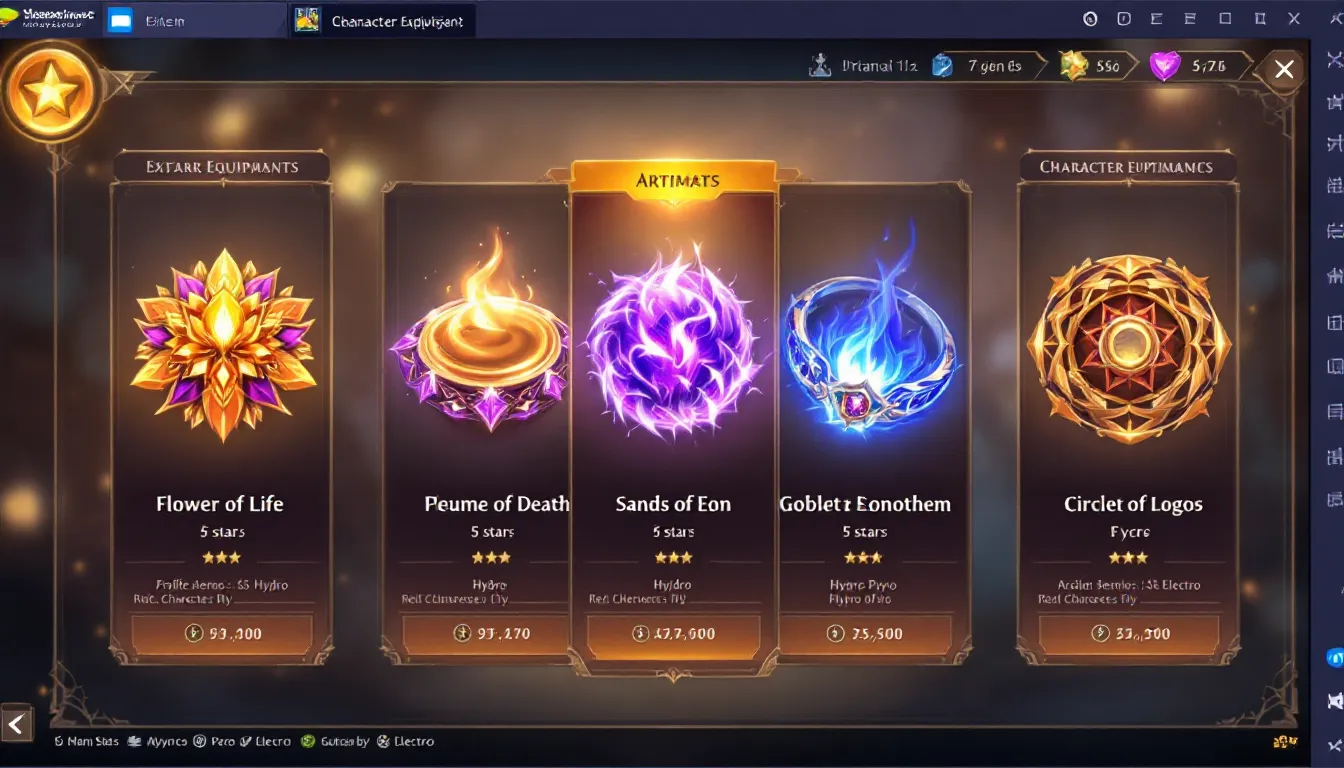
Artifacts in Genshin aren’t just stat-sticks, they’re narrative objects with visual identity. Each artifact set’s concept art tells a story.
The Crimson Witch of Flames artifact set concept art depicts ornate robes, crescent moon imagery, and crimson coloring. Together, these visual elements narrate a story about a powerful fire mage and her descent into obsession. A player who collects all five artifact pieces receives a complete visual narrative through the artwork.
Artifact concept art serves multiple purposes:
- Visual storytelling: Each artifact piece depicts different moments or aspects of a larger narrative. Collecting the full set provides story progression through images.
- Elemental clarity: Colors and visual themes communicate which element the artifact set benefits.
- Character fantasy reinforcement: A set designed for support characters might feature softer, less aggressive imagery than a set designed for DPS characters.
- Collectibility: Beautiful artifact art encourages players to hunt for complete sets even if they’re not optimally stat-rolled.
Designing artifact concept art requires balancing several constraints: the image must look good at the small icon size (where players see it most), but also impressive when viewed full-size. Concept artists create versions at multiple scales to ensure the design reads clearly whether it’s a 64×64 pixel icon or a full-resolution showcase.
The historical and cultural references in artifact concept art also matter. Artifact sets reference mythology, historical architecture, and cultural artifacts from real-world inspirations, all filtered through Genshin’s aesthetic lens. This adds depth for attentive players and reinforces regional identity when artifact sets are tied to specific regions.
Early artifact design (sets like Crimson Witch and Maiden Beloved from launch) feels slightly less refined compared to newer sets. This reflects evolution in miHoYo’s concept art sophistication. Newer artifact sets like Gilded Dreams and Deepwood Memories showcase more detailed illustration work, stronger visual storytelling, and better color theory application.
Where to Find Genshin Impact Concept Art and Behind-the-Scenes Content
Official Sources: Art Books, Livestreams, and Social Media
MiHoYo has made significant efforts to share Genshin Impact concept art with the community, understanding that visual culture is part of the game’s appeal.
Official art books represent the most comprehensive source. HoYoverse has released multiple hardcover concept art books through Chinese publishing channels, with some international availability. These books feature character design sheets (showing multiple angles and iterations), environmental concept art, weapon designs, and development notes. Pages often include artist commentary explaining design choices. These books are premium products, typically $40-60 USD, but provide unparalleled insight into the creative process.
Version livestreams (held roughly every six weeks) frequently feature concept art showcases for upcoming regions and characters. During livestreams, developers walk through concept sketches, showing early iterations and explaining why final designs evolved as they did. These livestreams are free to watch on platforms like YouTube and provide narrative context for upcoming content.
Official social media (@GenshinImpact on Twitter/X, HoYoverse’s official Discord) regularly shares concept art snippets. These are typically character design sheets, regional artwork, or behind-the-scenes process images. The community often reshares these extensively, so they trend quickly within Genshin circles.
HoYoLab (HoYoverse’s official community platform) occasionally hosts special concept art galleries. During anniversaries or major content drops, community managers post high-resolution concept art directly on the platform.
For players outside China, international availability can be limited for physical art books, though digital versions and scans circulate widely through community channels. Genshin Impact tools used by fan communities often aggregate official concept art, making it easily accessible.
Community Collections and Fan Showcases
Beyond official sources, the Genshin community has developed robust systems for archiving and celebrating concept art.
Reddit communities like r/Genshin_Impact and r/GenshinImpactNSFW maintain concept art archives. Dedicated users screenshot and curate concept art from official sources, making it discoverable through discussion threads and pinned posts. These communities often provide context, discussing design choices, comparing iterations, and analyzing artistic direction.
Twitter/X accounts dedicated to concept art aggregation have emerged. Accounts like @GenshinArtOfficial and similar fan-run pages post concept art with sourcing and translation of developer commentary. These accounts often have tens of thousands of followers, indicating community appetite for concept art content.
Fan wikis (particularly the comprehensive Genshin Impact Wiki and Fandom wiki) compile concept art in character pages and regional guides. These wikis organize concept art by category, making it easy for players to compare character designs, study weapon progression, or explore regional visual themes.
YouTube channels specializing in game design analysis frequently break down Genshin’s concept art. Analysis videos examine character design principles, discuss cultural references, and trace how concept art translated into final in-game implementation. Channels like Game Informer’s coverage and similar outlets occasionally feature detailed concept art retrospectives.
Pinterest and Tumblr communities maintain extensive boards dedicated to Genshin concept art. While these platforms are more aesthetic-focused than analytical, they serve as visual inspiration repositories where artists study Genshin’s design language.
One important note: unofficial wikis and community archives sometimes contain leaked or unreleased concept art. This is a gray area, while leaked art circulates, HoYoverse doesn’t officially endorse these sources. Official channels remain the most reliable and artist-supporting way to engage with concept art.
The Impact of Concept Art on Player Experience and Game Success
Concept art isn’t just a behind-the-scenes artifact, it directly influences how players experience Genshin Impact and, by extension, how successful the game has become.
Visual appeal is a primary driver of player retention in free-to-play games, where monetization depends on engagement. A player who finds the game visually stunning is more likely to spend time exploring, more likely to pull on new character banners, and more likely to recommend the game to friends. Genshin’s concept art directly enables this appeal. A new region launch with distinctive visual identity (like Sumeru in 2022) generates massive engagement spikes. Players specifically cite visual beauty as a reason they continue playing even though competitive disadvantages compared to games like Honkai: Star Rail.
Concept art also influences character meta and summon desirability. In gacha games, players pull on characters they want to use and characters they find visually appealing. A character with exceptional concept art, stunning design, cohesive color theory, distinctive silhouette, tends to generate more summon activity even if that character isn’t meta-optimal for Spiral Abyss. Characters like Fischl and Nahida experienced dramatic popularity surges partly because of visual redesigns (Fischl’s A4 rarity outfit, Nahida’s distinctive hair and clothing) that evolved their concept art.
The game’s positive reception in mainstream media partly stems from visual impact. Reviews on major outlets like IGN consistently praise Genshin’s art direction as a standout feature. That critical appreciation translates to player interest and cultural relevance beyond gaming circles.
Concept art also drives the passionate fan community. Fan art, cosplay, and creative works build on Genshin’s visual foundation. A character with striking concept art generates more fan creativity, which generates more buzz, which drives more players to try the game. This snowball effect has been critical to Genshin’s growth from 2020 through 2026.
MiHoYo has recognized the value of concept art as marketing material. Official art books, livestream showcases, and social media posts all function as low-cost, high-impact promotion. A single concept art post on HoYoLab can generate millions of views and drive awareness for upcoming content without traditional advertising expense.
The investment in concept art quality also signals production value to potential players. New free-to-play gamers comparing Genshin to competitors immediately notice the visual polish. That polish starts in concept art, it’s a commitment to artistic quality that reverberates through every layer of game development. Players recognize this commitment and reward it with engagement and monetization.
From a game design perspective, concept art informs gameplay mechanics. Character silhouettes inform hitbox design and animation clarity. Environmental concept art informs level design and dungeon architecture. Weapon concept art informs combat readability and animation timing. This integration means concept art isn’t decoration, it’s foundational to how Genshin feels to play.
A comprehensive guide to Genshin Impact emphasizes how character design (which originates in concept art) connects to optimal usage patterns. Players can “read” a character’s kit through design, a character with aggressive stance in concept art tends to function as an on-field DPS, while passive-posed characters tend to be supports. This visual-mechanical connection is deliberate, originating in concept art direction.
Conclusion
Genshin Impact’s visual dominance in the gaming landscape isn’t luck, it’s the result of meticulous concept art direction that infuses every character, region, weapon, and artifact. From initial sketches to final in-game implementation, miHoYo’s concept artists have established a visual language that feels cohesive, distinctive, and perpetually fresh.
The concept art pipeline demonstrates how foundational design work multiplies throughout production. A character’s visual identity established in 2D concept translates into gameplay mechanics, animation principles, and community engagement. Environmental concept art shapes how players explore Teyvat, influences how they feel about each region, and determines whether the world reads as believable and immersive.
As Genshin Impact continues beyond 2026, concept art will remain the bedrock of its competitive advantage. New regions, characters, and systems will build on the visual frameworks established since launch, evolving the game’s aesthetic without abandoning what makes it distinctive. For players and creators alike, understanding Genshin’s concept art process enriches appreciation for the game, it reveals the intentionality behind every visual detail and the artistry that transforms code into wonder. Whether you’re pulling for a character design that resonates with you or exploring a new region because its concept art captivates you, you’re experiencing the direct result of concept artists who understand that visual beauty is inseparable from great game design.